Friday, 11 October 2013
Digital healthcare - a road paved with good intentions?
Digital healthcare - a road paved with good intentions? from Richard Stanton on Vimeo.
A treat for all those interested in the use of technology in healthcare, this is a lecture that Professor James Morgan, who leads the implementation of the open-source electronic health record, Open Eyes, gave in Cardiff earlier this year. You can find out more about the Science in Public series of lectures here.

Sunday, 6 October 2013
Is your conference really 'trending'?
I've attended quite a few conferences (virtually and physically) in the last year since Twitter introduced 'tailored trends'. At nearly every conference someone will make an announcement that the hashtag is 'trending worldwide'. Usually it isn't and in fact the person who has thought this is instead looking at tailored trends. These are based on who you follow and where you are; so that you see topics which are popular amongst the people you follow. It means that if you are at a conference with many of the people you follow, then it is quite likely that you will see that hashtag trending as a 'tailored trend'.
How do you know you are looking at a 'tailored trends'? If you just see 'trends' then this is 'tailored trends'. If a geographical area is specified eg 'UK trends' then you are not seeing tailored trends.
It can be a little bit more difficult that this to tell, so I made this screencast last week which I think explains why sometimes people are confused.
At the end of the day it doesn't really matter if your conference hashtag is trending across the nation or not! If it is trending amongst the people you follow that is probably a much more important metric.
Thursday, 12 September 2013
Trying out Mozilla Popcorn Maker...
Mozilla Popcorn Maker is a tool which allows online video to be repurposed and made more 'interactive'. I learned about it today from this post by Neil Mehta.
This is a very simple edit of the 1st part of google hangout I did last week with Eve Purdy.
Was this an easy to use tool?There is certainly a learning curve- and it took me a few hours to edit this very short video. In part because it doesn't seem very stable of Chrome as it crashed a few times. So I don't think it is something that will have widespread take-up just yet, but I may be wrong!
The next thing I want to do is see how long it would take me to have done this same editing within YouTube itself. And then I might try adding some of the fancy features in Popcorn Maker .. eg links out.
Of course as Popcorn Maker themselves have tweeted the main advantage is that someone else can take what I have done and remix it and make it better.
@amcunningham thx for trying out Popcorn, main advantage besides hyperlinks are ability for others to remix and improve makes. Enjoy! :)
— Mozilla WebMaker (@webmaker) September 12, 2013
Maybe Eve Purdy will have a go herself!
Wednesday, 4 September 2013
Hanging out with Eve Purdy
"The future is already here – it's just not evenly distributed." - so said William Gibson in 2003. If you want to see the future of medical education then talk to students like Eve Purdy. She is a 3rd year medical student in Kingston, Ontario. She blogs and tweets. This morning I grabbed her for a quick chat. You can watch our 'google hangout on air' below.
Wednesday, 7 August 2013
#300seconds talk on health professionals and social media
What is #300seconds about? Getting more women to speak about digital and tech issues. I was one of the 12 speakers at the 1st event in May 2013. The event was hosted in the Facebook London offices.
Speaking to digital experts was challenging.I decided to focus on some of the non-technical issues around the healthcare and social media. Thanks for watching.
Things I mention:
'Trust is the God particle' - Fugeli 2001
The Digital Doctor conference
The story behind Regina Holiday's painting 'Office Hours'
danah boyd on privacy, control and context
Please think about signing up to speak at the next #300seconds event in September.
Sunday, 7 July 2013
BMJ Hack- Developing ideas and relationships (and a little bit of software!)
Home blood pressure recording app for diagnosis of from Anne Marie Cunningham
What a weekend!
I have to admit that yesterday morning getting up before 7am to go to London for BMJ Hack didn't seem such a great idea. It was going to be a beautiful sunny weekend and I was going to spend it inside thinking about how we could use some of the BMJ datasets to address 4 key challenges.
I was most interested in the 'digital student' theme- what could we do for medical education in a weekend? Fortunately there were some wonderful students about! Jon Hilton worked with a team to gamify the questions in OnExamination to try and make answering practice exam questions more fun. And I spent a good chunk of the day working with Tom Lewis, Mike Eddy and Alice Pallot on developing a calendar tool that would help students know about the learning opportunities happening around them when out on placement. I loved this. Even more amazing was that the whole development was done by two sixth-form students Harry and Vesko.
As we drifted into the evening the conversations continued. Rewired State had organised the hackday in a wonderful venue, The Hub. I had brought my sleeping bag and planned to stay over finding a bit of floor somewhere in the room. And I did! But before that, around midnight, I had a chance conversation with Andrea Weir, a developer who hadn't started working on a hack day project yet. She asked me what would make my life as a GP easier now. So I told her about how since the publication of the new NICE guidance on hypertension in 2012 we were increasingly using home BP monitoring to diagnose high blood pressure. I showed her the great web app that Ed Wallitt had started a few months ago so that patients could share their BP readings online with their doctor. We talked about how the patient is expected to take two sets of reading a day during their normal waking hours. And in each set there should be two readings taken at least one minute apart. That's quite a lot to remember, isn't it! So we thought we would try and make an app which would work offline and simply give the patient some information about how to record their BP, what it meant, and reminders if they didn't record two sets of reading each day. It would be specifically to help patients follow the diagnosis protocol and wouldn't depend on internet access. They would be able to see their own reading on whichever device they decided to use, and would then be able to take their phone with the average result to their doctor at the practice. Simple!
Andrea thought this was something she would like to give a go and when I woke up just after 7 she was still working away on it. Alok Matta also got involved and gave us some tips (and in between times we were seeing what we might be able to do with the content on the NHS Choices conditions site so a busy day!)We didn't get as far as we wanted but when it came to presentations we had enough to explain to people what we were trying to do. There were a lot of questions and some discussion about the use of SMS- could patients be sent SMS reminders instead if they didn't have a smartphone. This was a great idea. Smartphones and broadband are not ubiquitous where I work but there are few people that don't have a phone that can handle SMS. There were questions about doing research to see the impact of using the app- great questions.
The really, really massive shock was that we won. I think people liked it because it was working to try and improve the experience of patients today. Yes, we didn't get as far as we wanted with the development but there is lots of time to work on this. I'm looking forward to getting Ed involved again too and maybe we can work on it further at an NHS hack day. It's very exciting. But now I need a good night's sleep:)
Monday, 6 May 2013
Who is your audience? - Learning about burnout through social media
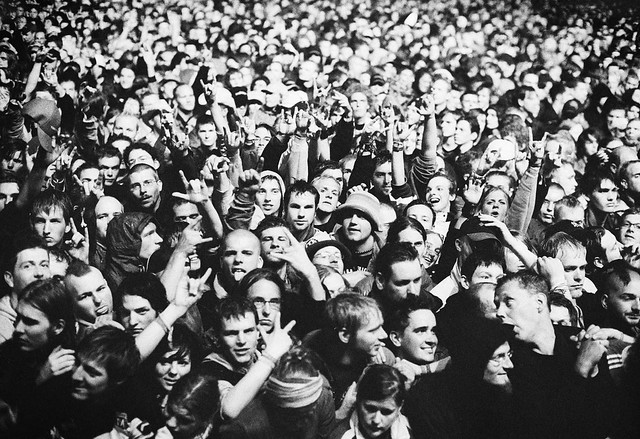
Image : Rock Audience by Peter Bongard
"The Rules"
Last week a new website appeared : The Moderate Doctor. The purpose of the website was to host "The Rules", which were originally described as follows"The Rules have been developed to help patients maximise their experience of consulting a GP, and give GPs a chance to vent their frustration at the sometimes bewildering world of the consultation. For anyone of a sensitive disposition-do take The Rules seriously! I hope everyone can find some therapeutic benefit in them-doctors and patients alike."
So from the start The Moderate Doctor was pretty clear that this was meant to be satire, although I did suggest to him that he removed any suggestion that these would help patients because I didn't think that it would. And he did. However, less than a week after publishing the rules are gone from the website. Dr Moderate has said the he meant this as some fun but that it wasn't worth the 'vitriol' and 'grief' which he had received and the he could do without the 'GMC imitators'. Personally, I do not think that the GMC would be interested in this blog or twitter account and if someone thinks that they would, it probably means that they don't understand the guidance on social media. Dr Moderate was not breaking any confidentialities, or doing anything else that I think is in conflict with Good Medical Practice.
Audience
So what audience was Dr Moderate aiming for? He is a keen cyclist and he had based the his rules on The Rules published on the Velominati's website. Who are the Velominati? They are' cycling disciples of the highest order" who spend their days "pouring over the very essence of what makes ours such a special sport and how that essence fits into cycling’s colorful fabric".Their website is for those who are DEDICATED to cycling. Their rules might not make that much sense to the rest of us but it is pretty clear that the rules are aimed at those who consider themselves as Velominati, and only those. There is satire but they are laughing at themselves and their own healthy obsession.
Dr Moderate was trying to achieve something much more difficult. His rules were not aimed at making fun of a set of super dedicated GPs, but seemed to be aimed at bonding with other doctors through joking about their patients. It wasn't clear that the focus of the joke was the doctor. That made some people feel uncomfortable. One member of the public wrote replies to the rules in his own document as he couldn't fit them all into the comments. In general there was quite a lot of confusion about who the rules and the satire was aimed at....
@drjohncosgrove @docmartin68 I know it's not aimed at me as a non-medic (or maybe it is!) but I found it patronising and insulting.
— Ermintrude (@Ermintrude2) May 1, 2013
Do The Rules raise bigger questions?
There is much talk of GP burnout at the moment. If you are a UK GP can take a survey on the Pulse website to assess how you score for measures of emotional exhaustion, depersonalisation, and lack of personal accomplishment which are recognised features of burnout. Clare Gerada writes in Pulse that "‘Everything else has increased our workload. The insistence that perfectly healthy people “see their GP” hauls demand for access to an unreasonable level and casts us in a role that we have never asked for." One of the doctors who is sad at the withdrawal of the rules mentions that it was good to know that there were other doctors who felt the same about abuse of the service. So it seems that increased workload may be behind The Rules and behind the concerns about GP burnout.
Is workload related to burnout? A study of medical students who applied to medicine in 1990 (McManus, Keely and Paise, 2004) measured personality traits and approaches to learning at baseline, and then followed them up in their final year or medical school, their PRHO year and again a few years later. They found the personality and learning style at baseline, predicted feelings of burnout at graduation and approach to work 5 years later. Medical students who were more extravert, had a deeper approach to learning, were less neurotic, and more agreeable were less likely to report burnout, stress and exhaustion later, and then a more positive attitude to work and a greater sense of accomplishment later still. So does personality lead to stress and burnout which then leads to work dissatisfaction rather than the other way round?
But there is some confusion about burnout too. How important is it? Does it affect the way that doctors practice or communicate? Two studies suggest that it might not. A study in the US by Ratanwongsa et al (2008) measured burnout in primary care doctors and then taped consultations with patients, assessed them against the ROTER scale and measured patient satisfaction. Burnout was correlated with patients saying more negative things as an attempt to build rapport, but otherwise there was no correlation with patient satisfaction. And in the UK a cross-sectional study of GPs by Orton et al (2012) found high levels of burnout, but when consultations with patients were examined the burnout was not obvious to observers, and there was no correlation with patient satisfaction. So when the results of the Pulse survey are announced we will need to ask what the significance is.
But social media is not somewhere that one can be guaranteed that one will be listened to compassionately and non-judgementally. Dr Moderate took quite a risk when he decided to share The Rules with the world. He has raised important issues and I do hope that we get the chance to explore them meaningfully. But at the same time I wouldn't blame him for wanting to avoid this space. I'll admit that my first reaction to his setting up a website to support one publication, which seemed to be based around a humourous denigration of patients, was not one of empathy or compassion. But perhaps it should have been.
Cole, T., & Carlin, N. (2009). The suffering of physicians The Lancet, 374 (9699), 1414-1415 DOI: 10.1016/S0140-6736(09)61851-1
McManus IC, Keeling A, & Paice E (2004). Stress, burnout and doctors' attitudes to work are determined by personality and learning style: a twelve year longitudinal study of UK medical graduates. BMC medicine, 2 PMID: 15317650
Orton, P., Orton, C., & Pereira Gray, D. (2012). Depersonalised doctors: a cross-sectional study of 564 doctors, 760 consultations and 1876 patient reports in UK general practice BMJ Open, 2 (1) DOI: 10.1136/bmjopen-2011-000274Is workload related to burnout? A study of medical students who applied to medicine in 1990 (McManus, Keely and Paise, 2004) measured personality traits and approaches to learning at baseline, and then followed them up in their final year or medical school, their PRHO year and again a few years later. They found the personality and learning style at baseline, predicted feelings of burnout at graduation and approach to work 5 years later. Medical students who were more extravert, had a deeper approach to learning, were less neurotic, and more agreeable were less likely to report burnout, stress and exhaustion later, and then a more positive attitude to work and a greater sense of accomplishment later still. So does personality lead to stress and burnout which then leads to work dissatisfaction rather than the other way round?
But there is some confusion about burnout too. How important is it? Does it affect the way that doctors practice or communicate? Two studies suggest that it might not. A study in the US by Ratanwongsa et al (2008) measured burnout in primary care doctors and then taped consultations with patients, assessed them against the ROTER scale and measured patient satisfaction. Burnout was correlated with patients saying more negative things as an attempt to build rapport, but otherwise there was no correlation with patient satisfaction. And in the UK a cross-sectional study of GPs by Orton et al (2012) found high levels of burnout, but when consultations with patients were examined the burnout was not obvious to observers, and there was no correlation with patient satisfaction. So when the results of the Pulse survey are announced we will need to ask what the significance is.
Where can doctors tell their stories?
Cole and Carlin (2009) write in the Lancet, that burnout is "also a euphemism for what many physicians experience as a crisis of meaning and identity". One of the solutions is for doctors to be able to tell their stories and to be compassionately and non-judgementally listened to. Can social media have a role in this? Jonny Tomlinson's blog is probably one of the most potent examples of this. His latest post is on the impact that loneliness can have on patients and how they present to their doctors. Last year he moved many people, including me, with his post on how medicine, and we doctors. might make our patients feel shame. But his blog is only one place that he can tell his story. He has written about how he still meets every three weeks with a group of GPs who he trained with 11 years ago.But social media is not somewhere that one can be guaranteed that one will be listened to compassionately and non-judgementally. Dr Moderate took quite a risk when he decided to share The Rules with the world. He has raised important issues and I do hope that we get the chance to explore them meaningfully. But at the same time I wouldn't blame him for wanting to avoid this space. I'll admit that my first reaction to his setting up a website to support one publication, which seemed to be based around a humourous denigration of patients, was not one of empathy or compassion. But perhaps it should have been.
Cole, T., & Carlin, N. (2009). The suffering of physicians The Lancet, 374 (9699), 1414-1415 DOI: 10.1016/S0140-6736(09)61851-1
McManus IC, Keeling A, & Paice E (2004). Stress, burnout and doctors' attitudes to work are determined by personality and learning style: a twelve year longitudinal study of UK medical graduates. BMC medicine, 2 PMID: 15317650
Ratanawongsa, N., Roter, D., Beach, M., Laird, S., Larson, S., Carson, K., & Cooper, L. (2008). Physician Burnout and Patient-Physician Communication During Primary Care Encounters Journal of General Internal Medicine, 23 (10), 1581-1588 DOI: 10.1007/s11606-008-0702-1

Subscribe to:
Posts (Atom)