Showing posts with label confidentiality. Show all posts

Saturday, 4 May 2013

Balancing personal and professional presence in social media.


During the week I was talking to some of the doc2doc team and they asked me what I thought about the GMC guidance on social media.

I think that the guidance is good in that it states that the use of social media can very positive and worthwhile for any doctor. I think that it is likely to increase engagement with social media for doctors, and through that provide many opportunities for learning. It doesn't provide guidance on some of the issues which I think are important, for example, what responsibilities does a doctor have before encouraging patients to engage in a social media space. We will have to wait for future iterations to deal with these scenarios.
But within the twittersphere and blogosphere the reaction has been dominated by controversy over the  statement that "If you identify yourself as a doctor in publicly accessible social media, you should also identify yourself by name."
I still hear people talking about the guidance being impossible to operationalise because how will the GMC identify these pseudonymous doctors? But why would they be trying to? No one would know if that person was really a doctor or not. The GMC have clearly said that the guidance does not "change the threshold for investigating concerns about a doctor's fitness to practice". This means that being anonymous/pseudonymous will never be an issue in itself. But if it was established that a doctor was for example bullying a colleague, or breaking patient confidentiality, then the fact that they were doing this without revealing their identity might be seen as being an aggravating factor.
Some people say that the guidance can't protect the public from charlatans who represent themselves as doctors when they are not. Well, in a way it does. If it is good practice to identify yourself then we can tell the public that they should not trust the authority of any one who represents themselves as a doctor, but  does not identify themselves, and then tries to give them advice.

When I tweeted the link to this interview earlier, Phil replied


Is it possible to separate medical and personal presence on Twitter? Why would you want to? Are doctors concerned that their personal interests or feelings will affect their relationships with colleagues or patients? If so then they may wish to try and separate our these different parts of their identity by setting up more than one account. But personally  I'm happy enough to tweet about going to a gig from my @amcunningham twitter account. Why would or could a tweet like the one that follows be an issue?


A few weeks ago I was asked to write a few paragraphs on how I think about how I present myself online for this ebook on "Social Media and Mental Health Practice".


How do I present myself online?

I first started using social media because I wanted to network so that I could do my job in medical education better. Yes, I am also a GP but I did not see social media as something that would help me to be a better doctor. I’m still not sure that it does, although I certainly do not think that it makes me a worse one. But I am very aware that most of what I say and do within social media is public. I want it to be that way. I do not aim what I say at my patients (or students) but I’m aware that they might read it, and I do not want them to be shocked or upset or worried by anything that they see me write. I aim to be professional, and I aim to respect professional boundaries.


When I am in the consulting room I reveal very little personal information. I doubt that patients are really interested. They walk in to see me and want and need to talk about them, not me. They often politely ask how I am. If I’m running late, I might smile and say, ‘Busy!’ But I would not share my own personal woes and worries with a patient. It would be wrong for me to burden them with my personal concerns. Of course, if they ask did I enjoy my holiday we might chat briefly about that. I don’t close down these conversations but I would never initiate talk about myself.

I share very little personal information online. I do not usually talk about my friends or family publicly online, and this is often to protect their privacy. However, this year I am sharing a photo that I take every day. In some ways this often reveals more personal information about me that what I write. It is something that I am aware of but rarely feel constrained by. I think that in many ways I am quite a private person, so this maybe more than being ‘professional’ defines how I am online.

Of course I might share some difficulties online, for example struggling to make technology work just the way I want it to! I don’t think that is a problem. It shows a different side of me and it is unlikely to impact in any way on the professional relationships which are important to me.I have thought about how I present myself online over the years. I try to be calm, collected, honest and independent. I hope that I come across as I do when I am offline. I am proud that when I meet people offline, who have first known me through social media, they often say that they feel as if they know me already. I would be unhappy if my online presence was considered inauthentic, so this pleases me.

 How do you manage the boundaries between personal and professional? What are the issues for you?

Saturday, 30 June 2012

Case discussion on Twitter: how can we make best practice explicit?

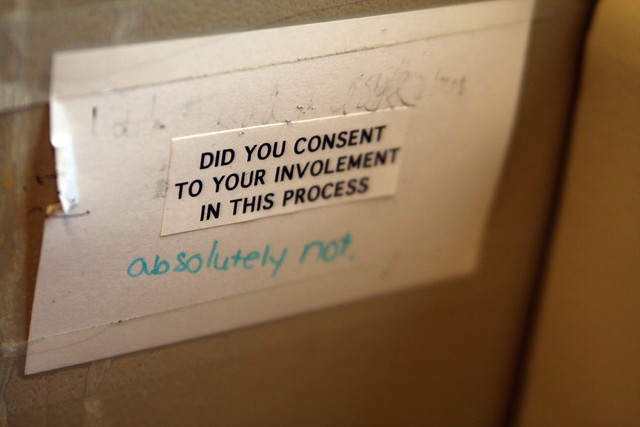
Did you consent to your involvement in this process?
Image by quinn.anya

It's great to see the growth of discussion in medical education on Twitter. Recently I have seen a few really interesting cases being discussed (and a lot being learned), but there have also been some questions about how we together can think about what is best practice in leading these discussions.

Case discussions have always been a very important way of learning in medicine. And as one doctor said, junior staff are still encouraged to submit cases to journals, but it can take many months for a case submitted to a journal to reach publication. In the meantime, social media removes those barriers to publication. We can all self-publish. But we have to be responsible too. I think that all of the people currently involved in leading discussions are being responsible, but how do we make clear to others what best practices we are following? I think that it is important to consider this for a few reasons. First, we have an obligation to all patients to make these discussions safe. Second, we are modelling how to share these cases to other students and professionals.

We also need to think about whether the existing guidance, which in the UK is from the GMC, is sufficient to guide us.

So a few questions....

What should we tell patients about sharing their story? Do we need their consent if the story is not recognisable to others?
When the GMC discuss confidentiality the emphasis is on not sharing information (without consent) that would allow another to recognise a patient or someone close to them. In the new draft guidance on social media the only additional emphasis is on the impact of embedded information such as GPS co-ordinates that would allow us to know from where a tweet was made, or an image taken. 

My own practice is that if I want to share a story about a patient that might allow them to recognise themselves then I ask permission, and I record that when sharing the story. So far this has only happened once and it was in a blog post. How could it be conveyed that a patient was aware and happy that their story was being shared on Twitter? If this is done in a separate tweet then those following the tweets may miss it and wonder if permission has been given. Is this something we need to be concerned about?

What about sharing images routinely made as part of care?


In 2011 the GMC gave additional guidance on the audio-visual recordings. For some images made as part of routine care, such as pathology slides, internal images of organs, and xrays,  then no specific consent to take the images is needed. It is presumed that if the patient gives consent to the procedure then they give consent to the image being recorded. The guidances says that attempts should be made to make patients aware that they may be shared in an anonymised form, but there is no need to ask permission before doing this. This includes for publication in widely-accessible media such as press, print and internet. We can presume this includes Twitter!  

The draft social media guidance makes no additional comment on this so sharing an anonymised image on Twitter for teaching purposes seems acceptable. But images are rarely of much value without an accompanying story. So we are back to the situation above. How much permission is it good practice to obtain before sharing a story? And we have to remember that the real-time nature of social media means that a story about a patient might be shared as it is happening, rather than six months later, so that it is more likely that people may recognise themselves or others.

Other images that are made as part of routine care, but are not part of a procedure, such as an image of the outside of the body, do need specific consent to be given. And again patients should be made aware that these images may be used for teaching or research, but specific consent does not have to be given for them to be shared for this purpose as long as they are anonymised and all identifying details are removed. However, the guidance states that if the image is to be shared in widely accessible media (eg Twitter or a blog) then if the image is identifiable consent must be obtained. If the image has been anonymised then good practice is that consent should also be obtained but," if it is not practicable to do so, you may publish the recording, bearing in mind that it may be difficult to ensure that all features of a recording that could identify the patient to any member of the public have been removed."

What about recording an image to share in an educational discussion on social media?


The GMC guidance which applies here is the section on "recordings for use in widely accessible public media". Here, even if the patient is not identifiable, and has been anonymised, consent must be given explicitly. Paragraph 37 states:
"You must get the patient's consent, which should usually be in writing, to make a recording that will be used in widely accessible public media, whether or not you consider the patient will be identifiable from the recording"
We are also obliged to check with our employers what their policies are. Some trusts prohibit the use of mobile phone cameras by staff to protect patient confidentiality.

If consent has been obtained from patients to share their non-identifiable images online, how can we share that information in a tweet? Can we presume that if we see an image shared on Twitter then the person sharing it has followed the correct policies, just as when we see an image in a journal we might presume that the correct policies have been followed? Should those leading case discussions develop their own policies and make these accessible from their Twitter profile?

Medical education on Twitter is fantastic. There are no professional or geopgraphic boundaries to discussions. And no boundaries to patients participating either! I want to see all that is happening already continue and also for more people to get involved. I think that by considering these issues and showing how we can be safe and transparent we can take these discussions to a new level of participation.

Thursday, 5 August 2010

My thoughts on Health Professionals and Social Media

Health professionals and social media
View more webinars from Anne Marie Cunningham.
What do you think? If you are short of time you may wish to skip to slide 16.
EDIT 29/9/2010 : At 6min10sec I refer to 'social marketing' when I actually mean the use of social media for marketing. "Social marketing" is a different concept and is well explained here. Near the end when I talk about the possible public health benefits of using social media to influence social networks, this would be a true use of 'social marketing'.