Showing posts with label health professionals. Show all posts

Friday, 13 December 2013

Social media as part of a new professionalism : #GMCConf

Add caption
Two years ago I attended a GMC education conference in the London. The conference had no hashtag so I and some others decided to use #GMCEd11 . The GMC didn't have their @gmcuk account at that time but they did have a @gooddoctoruk account launched around the time of initial consultation on the updating of Good Medical Practice. Altogether there were just over 300 tweets made on the day and about half of those were by me. Most of this activity probably bypassed those who were attending except when I had a chance to ask a question to an afternoon panel on behalf of Alastair McLellan, editor of the Health Services Journal. Alastair had posed the question to me in a tweet. I remember a frisson of laughter that a question was coming via twitter and I think that it was Fergus Walsh who joked that at least 140 characters created  usefully brief and succinct questions.

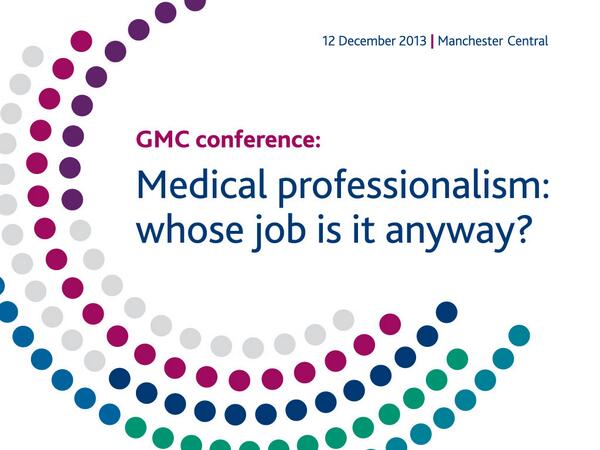
Fast forward to 2013 and the first national GMC conference on 'Medical professionalism : whose job is it anyway?' is held today in Manchester with 400 attendees- over 50% of them medical students and jobbing doctors, but with other stakeholders including patients well represented. There is an official conference hashtag #gmcconf and it is used more than 1500 times today. Throughout the day there is reference to taking questions from tweets and no-one seems to be in any way surprised.

I make about 1/2 the tweets I do at the last event, in part because this time I was giving a lunch-time seminar with Gareth Williams from the GMC office in Cardiff on the social media in practice. A strong conference theme is the nature of professionalism in a post Berwick and Francis report world and so my part of the session focussed on how social media is being used to drive improvement and ensure patient safety by doctors in the UK today.

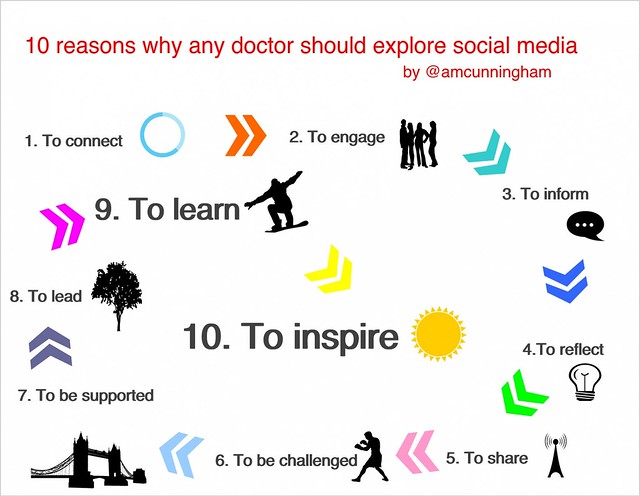
10 reasons why any doctor should explore social media

I concentrated on a few stories - Elin Roddy's experiences of learning and reflecting in social media which lead to her taking on the role of lead for End of Life care in her trust ; raising patient safety through openness and transparency of sharing the #Wrongfooted storify ; NHS Change Day ; the FOAMed initiatives of ECGClass, Gasclass and TeamHaem ; and Kate Granger's #HelloMyNameIs campaign.

A few years ago I was not confident that I could justify urging every doctor to explore social media. But it is now beyond doubt that some of the most innovative, creative and transformative conversations about improving the care of and with our patients are happening within social media.

We must ask ourselves what we can do to help our colleagues and students be part of these conversations.

Friday, 11 October 2013

Digital healthcare - a road paved with good intentions?


Digital healthcare - a road paved with good intentions? from Richard Stanton on Vimeo.

A treat for all those interested in the use of technology in healthcare, this is a lecture that Professor James Morgan, who leads the implementation of the open-source electronic health record, Open Eyes, gave in Cardiff earlier this year. You can find out more about the Science in Public series of lectures here.

Wednesday, 4 September 2013

Hanging out with Eve Purdy

"The future is already here – it's just not evenly distributed." - so said William Gibson in 2003. If you want to see the future of medical education then talk to students like Eve Purdy. She is a 3rd year medical student in Kingston, Ontario. She blogs and tweets. This morning I grabbed her for a quick chat. You can watch our 'google hangout on air' below. 


Wednesday, 7 August 2013

#300seconds talk on health professionals and social media


What is #300seconds about? Getting more women to speak about digital and tech issues. I was one of the 12 speakers at the 1st event in May 2013. The event was hosted in the Facebook London offices.

Speaking to digital experts was challenging.I decided to focus on some of the non-technical issues around the healthcare and social media. Thanks for watching.

Things I mention:
'Trust is the God particle' - Fugeli 2001
The Digital Doctor conference
The story behind Regina Holiday's painting 'Office Hours'
danah boyd on privacy, control and context

Please think about signing up to speak at the next #300seconds event in September.


Saturday, 4 May 2013

Balancing personal and professional presence in social media.


During the week I was talking to some of the doc2doc team and they asked me what I thought about the GMC guidance on social media.

I think that the guidance is good in that it states that the use of social media can very positive and worthwhile for any doctor. I think that it is likely to increase engagement with social media for doctors, and through that provide many opportunities for learning. It doesn't provide guidance on some of the issues which I think are important, for example, what responsibilities does a doctor have before encouraging patients to engage in a social media space. We will have to wait for future iterations to deal with these scenarios.
But within the twittersphere and blogosphere the reaction has been dominated by controversy over the  statement that "If you identify yourself as a doctor in publicly accessible social media, you should also identify yourself by name."
I still hear people talking about the guidance being impossible to operationalise because how will the GMC identify these pseudonymous doctors? But why would they be trying to? No one would know if that person was really a doctor or not. The GMC have clearly said that the guidance does not "change the threshold for investigating concerns about a doctor's fitness to practice". This means that being anonymous/pseudonymous will never be an issue in itself. But if it was established that a doctor was for example bullying a colleague, or breaking patient confidentiality, then the fact that they were doing this without revealing their identity might be seen as being an aggravating factor.
Some people say that the guidance can't protect the public from charlatans who represent themselves as doctors when they are not. Well, in a way it does. If it is good practice to identify yourself then we can tell the public that they should not trust the authority of any one who represents themselves as a doctor, but  does not identify themselves, and then tries to give them advice.

When I tweeted the link to this interview earlier, Phil replied


Is it possible to separate medical and personal presence on Twitter? Why would you want to? Are doctors concerned that their personal interests or feelings will affect their relationships with colleagues or patients? If so then they may wish to try and separate our these different parts of their identity by setting up more than one account. But personally  I'm happy enough to tweet about going to a gig from my @amcunningham twitter account. Why would or could a tweet like the one that follows be an issue?


A few weeks ago I was asked to write a few paragraphs on how I think about how I present myself online for this ebook on "Social Media and Mental Health Practice".


How do I present myself online?

I first started using social media because I wanted to network so that I could do my job in medical education better. Yes, I am also a GP but I did not see social media as something that would help me to be a better doctor. I’m still not sure that it does, although I certainly do not think that it makes me a worse one. But I am very aware that most of what I say and do within social media is public. I want it to be that way. I do not aim what I say at my patients (or students) but I’m aware that they might read it, and I do not want them to be shocked or upset or worried by anything that they see me write. I aim to be professional, and I aim to respect professional boundaries.


When I am in the consulting room I reveal very little personal information. I doubt that patients are really interested. They walk in to see me and want and need to talk about them, not me. They often politely ask how I am. If I’m running late, I might smile and say, ‘Busy!’ But I would not share my own personal woes and worries with a patient. It would be wrong for me to burden them with my personal concerns. Of course, if they ask did I enjoy my holiday we might chat briefly about that. I don’t close down these conversations but I would never initiate talk about myself.

I share very little personal information online. I do not usually talk about my friends or family publicly online, and this is often to protect their privacy. However, this year I am sharing a photo that I take every day. In some ways this often reveals more personal information about me that what I write. It is something that I am aware of but rarely feel constrained by. I think that in many ways I am quite a private person, so this maybe more than being ‘professional’ defines how I am online.

Of course I might share some difficulties online, for example struggling to make technology work just the way I want it to! I don’t think that is a problem. It shows a different side of me and it is unlikely to impact in any way on the professional relationships which are important to me.I have thought about how I present myself online over the years. I try to be calm, collected, honest and independent. I hope that I come across as I do when I am offline. I am proud that when I meet people offline, who have first known me through social media, they often say that they feel as if they know me already. I would be unhappy if my online presence was considered inauthentic, so this pleases me.

 How do you manage the boundaries between personal and professional? What are the issues for you?

Wednesday, 10 April 2013

Hospital doctors contacting GPs...

The following storify is from a conversation earlier today. Many hospital doctors talk about finding it hard to contact primary care, just as GPs find it hard to get in touch with them. I'm posting it here so that you might share some of your solutions.

Talking about social media and health professionals....

I came across a Guardian  article on how to delete yourself from the internet this evening. That would be quite a task for me. It mentions a search engine, duckduckgo.com, which does not track internet searches. I decided to check out how good it was by searching for myself. It is good.

Through it I managed to find this video of a conversation between Clare Gerada, chair of the Royal College of General Practitioners (@clarercgp), Stephanie Bown, director of policy, comms and marketing at the Medical Protection Society (@drstephbown), and myself. We were ably chaired by Sharon Alcock, journalist and  founder of Lime Green Media (@LimeandGinger).

The chat took place at an event last year where we were discussing the RCGP and DNUK producing guidance on social media. The final version of the RCGP Social Media Highway Code was published last month.

I had seen this before on the DNUK website but as far as I knew it was not available publicly so I am very pleased to be able to share it with you now. It's quite a lively discussion! Should GPs be discussing patients' underwear on their blog? <- No! Will we be doing consultations via Tweetdeck in the future? <- I doubt it. How will be deal with the digital divide? <- to be decided.

Let me know what you think.

Sunday, 4 November 2012

Digital divide, health records access and online security


Oxford Internet Study 2011 http://oxis.oii.ox.ac.uk/blog/non-users-and-ex-users-looking-lifestage-education-and-income

The 'digital divide' is very real. The Oxford Internet study is conducted every two years and the above chart is from their most recent survey in 2011. Level of income here relates to household income rather than individual outcome. If you live in a household with an income above £40K it is almost guaranteed that you will have online access. If you live in a poor household with an income of less that £12.5K it is most likely that you won't. There are also stark divisions related to age and educational levels described here.

I've just been having an interesting discussion with Amir Hannan, a GP who is a very strong advocate of patient access to their own health records, about how the digital divide means that those who are most likely to have health problems are least likely to be online... bringing us in the direction of a digital 'inverse care law'.

So if you are a GP and are encouraging patients to access their records online what would you say to those who lack the means to be online? Amir said that patients who are not yet online are directed to a course run by the local library which helps to get people online. But what if you can not afford to have your own access at home, should patients be encouraged to access their medical records from public places such as libraries or internet cafes? What are the risks? Or what about using a computer at the house of friends or family?

Of course, it's not only those who don't have their own computers at home who may use other computerss that they do not own themselves. What issues should you be concerned about if accessing your records from a computer that is also shared with your family or from your work place? Or a hotel lobby when on holiday?

A quick search does not reveal guidance about these issues for people in the UK. Here is the log-in page for the EMIS general practice records access. There is no link to information about online security. Contrast this with information which is available from online banking websites on what to look out for when using their services, for example here is a page on online security from Intelligent Finance.

If there are issues around the online security of accessing health records online, then those who don't have their own internet access at home, are more likely to be at risk. Do you have any examples of links to information in easy to understand forms which will help people to understand and address these issues? Or is it not an issue at all?

EDIT: some great guidance from BCS on accessing records http://www.bcs.org/upload/pdf/social-care-records.pdf <- they state if possible not to access from public computers, but if you do to clear browsing history.*** note this guidance is draft and NOT FOR CIRCULATION but I found it through Google ;-) ***

Saturday, 30 June 2012

Case discussion on Twitter: how can we make best practice explicit?

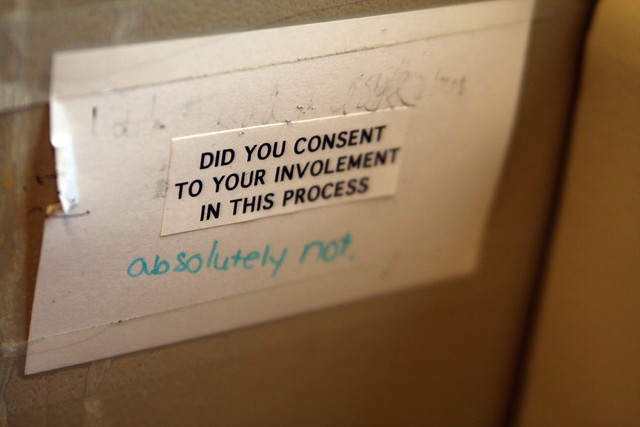
Did you consent to your involvement in this process?
Image by quinn.anya

It's great to see the growth of discussion in medical education on Twitter. Recently I have seen a few really interesting cases being discussed (and a lot being learned), but there have also been some questions about how we together can think about what is best practice in leading these discussions.

Case discussions have always been a very important way of learning in medicine. And as one doctor said, junior staff are still encouraged to submit cases to journals, but it can take many months for a case submitted to a journal to reach publication. In the meantime, social media removes those barriers to publication. We can all self-publish. But we have to be responsible too. I think that all of the people currently involved in leading discussions are being responsible, but how do we make clear to others what best practices we are following? I think that it is important to consider this for a few reasons. First, we have an obligation to all patients to make these discussions safe. Second, we are modelling how to share these cases to other students and professionals.

We also need to think about whether the existing guidance, which in the UK is from the GMC, is sufficient to guide us.

So a few questions....

What should we tell patients about sharing their story? Do we need their consent if the story is not recognisable to others?
When the GMC discuss confidentiality the emphasis is on not sharing information (without consent) that would allow another to recognise a patient or someone close to them. In the new draft guidance on social media the only additional emphasis is on the impact of embedded information such as GPS co-ordinates that would allow us to know from where a tweet was made, or an image taken. 

My own practice is that if I want to share a story about a patient that might allow them to recognise themselves then I ask permission, and I record that when sharing the story. So far this has only happened once and it was in a blog post. How could it be conveyed that a patient was aware and happy that their story was being shared on Twitter? If this is done in a separate tweet then those following the tweets may miss it and wonder if permission has been given. Is this something we need to be concerned about?

What about sharing images routinely made as part of care?


In 2011 the GMC gave additional guidance on the audio-visual recordings. For some images made as part of routine care, such as pathology slides, internal images of organs, and xrays,  then no specific consent to take the images is needed. It is presumed that if the patient gives consent to the procedure then they give consent to the image being recorded. The guidances says that attempts should be made to make patients aware that they may be shared in an anonymised form, but there is no need to ask permission before doing this. This includes for publication in widely-accessible media such as press, print and internet. We can presume this includes Twitter!  

The draft social media guidance makes no additional comment on this so sharing an anonymised image on Twitter for teaching purposes seems acceptable. But images are rarely of much value without an accompanying story. So we are back to the situation above. How much permission is it good practice to obtain before sharing a story? And we have to remember that the real-time nature of social media means that a story about a patient might be shared as it is happening, rather than six months later, so that it is more likely that people may recognise themselves or others.

Other images that are made as part of routine care, but are not part of a procedure, such as an image of the outside of the body, do need specific consent to be given. And again patients should be made aware that these images may be used for teaching or research, but specific consent does not have to be given for them to be shared for this purpose as long as they are anonymised and all identifying details are removed. However, the guidance states that if the image is to be shared in widely accessible media (eg Twitter or a blog) then if the image is identifiable consent must be obtained. If the image has been anonymised then good practice is that consent should also be obtained but," if it is not practicable to do so, you may publish the recording, bearing in mind that it may be difficult to ensure that all features of a recording that could identify the patient to any member of the public have been removed."

What about recording an image to share in an educational discussion on social media?


The GMC guidance which applies here is the section on "recordings for use in widely accessible public media". Here, even if the patient is not identifiable, and has been anonymised, consent must be given explicitly. Paragraph 37 states:
"You must get the patient's consent, which should usually be in writing, to make a recording that will be used in widely accessible public media, whether or not you consider the patient will be identifiable from the recording"
We are also obliged to check with our employers what their policies are. Some trusts prohibit the use of mobile phone cameras by staff to protect patient confidentiality.

If consent has been obtained from patients to share their non-identifiable images online, how can we share that information in a tweet? Can we presume that if we see an image shared on Twitter then the person sharing it has followed the correct policies, just as when we see an image in a journal we might presume that the correct policies have been followed? Should those leading case discussions develop their own policies and make these accessible from their Twitter profile?

Medical education on Twitter is fantastic. There are no professional or geopgraphic boundaries to discussions. And no boundaries to patients participating either! I want to see all that is happening already continue and also for more people to get involved. I think that by considering these issues and showing how we can be safe and transparent we can take these discussions to a new level of participation.
Wednesday, 8 February 2012

Would you block your patient on Twitter?

Road Block by PSP Photos
Road Block, a photo by PSP Photos on Flickr.


This question came about because I had tweeted a link to some research which had shown that 1/3 of practicising physicians, who responded to a survey (with a 14% response rate)  and said they used Facebook , had been issued with a friend request by a patient or their carer. This was much higher than the level reported in more junior doctors and medical students.

So should doctors refuse friend requests from patients? I have never had a Facebook request from a patient but if I had I would explain that I keep that account for close friends and family. A Facebook request can just be ignored which is an essentially passive act.

But I wouldn't block a patient from following me on Twitter. My Twitter presence is not orientated towards patients but I don't think that they would find anything shocking or surprising in my tweets. It would give them an insight into what I do when I am not in the practice. I consider that patients, or colleagues or students might read everything that I write here or on Twitter or anywhere else publicly online so I wouldn't worry about that.

A few people did think that patients should be blocked however. We discussed that this wouldn't necessarily stop them accessing the tweets as one only has to look at the profile instead. And blocking someone on Twitter is quite a hostile and aggressive act. I think I would find it hard to explain why I was doing that. One doctor said that he had blocked a young, female patient from his Twitter account because he wanted to set clear boundaries.

Another option, as the BMA guidance on the use of social media suggests, is to consider protecting your Twitter account and only allowing approved followers to see Tweets. In my experience the vast majority of doctors in the UK do have public accounts and I don't know if patients accessing tweets is a factor for those who choose to protect their accounts.

And how would I respond to a patient asking me for information on Twitter? Say they asked me where was the best place to find information about diabetes? Well, I would reply and point them to some good sources of information. And what if they were to ask me about their medical condition? If they were following me I would send them a DM advising that I can't give medical advice on Twitter but to get in contact with me in the surgery. I'd also advise them that their tweets are public and that that they might want to be careful about sharing sensitive information so it might be best to delete them. Normally I wouldn't send a DM to someone who I was not following as they would not be able to reply. But I think that in this case it might be the easiest way to deal with the situation. I wouldn't feel comfortable talking to a patient about a medical problem in 140 chtrs even if they were private messages. Essentially, I would treat a patient no differently to any other person I meet on Twitter. And since many people do not use real names on Twitter, and I have no way of remembering the names of all the patients registered with our practice it would be an impossible task to block all patients anyway.

I wouldn't follow my patients on Twitter. But perhaps I will change my mind about this. Perhaps following people from the area could give me better insights into what it is like living in the area and how I might be a better advocate for the community. Have no doubt however that the digital divide is real. A few weeks ago we were having a #nhssm (NHS social media) discussion on using video services such as Skype with patients when Evan Hilton, the executive director of Gofal, the Welsh mental health charity tweeted about the issue of digital in/exlusion in the South Wales valleys. He followed it up with this statistic:

Our patients face many challenges (often beyond their control) in staying health or living with illness. We haven't yet figured out how social media can be best used to help them but perhaps there is a case for not putting more blocks in the road. What do you think?

Saturday, 5 November 2011

On being public : How social media reshapes professional identity.

This was my presentation at ALT-C (conference of the Association for Learning Technology) earlier this year. It sums up in 20 minutes a lot of the thoughts and ideas that are covered in this blog. But of course it raises more questions than answers- I hope!


Sunday, 30 October 2011

Social Media Monitoring in Healthcare

Search Privacy
Search Privacy by Mushon

One year ago a story was shared on the nhssm (NHS social media) blog. The story was about what happened when St. George's trust in London started monitoring Twitter for mention of their name. Social media monitoring is a practice that is becoming increasingly common for businesses and it is not surprising that there is increasing discussion about this in healthcare.

Generally talk about the use of social media in the NHS tends to be driven by people who work in communications teams. This is evident from the programme of the first joint conference between NHSSM and Guardian healthcare, Social Media in Healthcare. None of the presenters are from a clinical background although I believe that another conference is possibly being planned. It is my belief that clinicians (doctors, nurses and other health professionals) and patients should be involved in developing social media strategies for any healthcare organisation.

Back to the St. George's story. When the team started monitoring they came across tweets from a patient who had recently had a renal transplant. Something in his tweets concerned the communications team and because no policy had been devised on how to handle a situation like this they were uncertain what next steps to take. Eventually the patient's clinical team were made aware of the patient's tweets. The patient only became aware of all of this when his consultant mentioned the tweets to him in a consultation.

The story provoked a lot of discussion with 39 responses and a follow up post by Dr. Dan O'Connor on the ethics of social media monitoring in healthcare. I urge you to read both of these posts and have a look at the comments. I've made several comments on both.

Generally I have not come across a lot more discussion of this topic in the last year. I'm not sure if many NHS organisations have developed policies on social media monitoring and I'm not sure how many have involved clinical staff or patients in developing these policies. In fact, I might not have thought a lot more about this if I hadn't attended a breakfast meeting at Evidence 2011 by Ben Breeze of Dell. He talked about how individual members of staff, outside the comms team as far as I understand, were being trained to represent the organisation.

So I am wondering what you think about this. What would be gained from an NHS organisation monitoring social media for mention of their name? Who should be involved in developing policies? How should clinical staff be involved? What are the risks and benefits?

Wednesday, 14 September 2011

Social media, black humour and professionals...

Beware of slang
Last week I presented at #altc2011 (the Association for Learning Technology Conference). My topic was "On being public.... how social media reshapes professional identity". One of my main points was that social media almost necessitates a reflexivity which we can get by without in face to face encounters. The pace of interaction is fast, we're dealing with people we may not otherwise come across, and norms are still being established. In fact we may never even get to the stage of having 'social norms'. Probably the only way to operate in these spaces is by having internalised your own values, but also being able to step outside of those values and to see what has shaped who you are and what you think, and to afford the same courtesy to others.

A few days later I came across a discussion between several male doctors on twitter which caused me to reflect on this very topic. The doctors were using slang, which I have not come across before, to refer to the wards in which they might have been working. The terms used were 'labia ward' and 'birthing sheds' to refer to the delivery suite where women give birth, and "cabbage patch" to refer to the intensive care ward where many patients are unconscious. 

I was shocked at this and angry and did query the doctors about some of the other things they said, but I felt I couldn't challenge them directly at that time about this language. One of the doctors referred to midwifes as 'madwives' and was challenged by a medical student to justify this position. In the meantime I pulled together the tweets using a curation tool and informed the doctors involved that I had done this. I did not tweet the link publicly and did not endeavour to have a conversation in public about this. However I did feel the need to check with others how they felt about this exchange so I sent them a link to the collated tweets by private message. I wanted to find out if my own shock and revulsion was  typical and also to gain some advice on what to do about this.  

Almost all replies stated that they found the discussion insensitive. Doctors seemed to be as likely to be offended as non-doctors. Some thought that this was risky behaviour because regulators may take action. I personally think this is very unlikely and do not consider these tweets a disciplinary offence.

But what happened in public? A few others (mainly other doctors) did challenge the use of this language. The protagonists explained that they thought their tweets should be interpreted as a conversation between medical professionals. One expressed that he did not want to cause offence and that he perhaps had misjudged sending the tweet.

How did I feel?
I was surprised at the strength of my reaction to this. I wanted to let it pass but I also felt that this was not appropriate. I felt that the language objectified women and was misogynistic. I privately told one of the doctors this and asked that he removed the tweets but he refused to do so and suggested that my feelings of offence were my problem.

Some doctors have thought that I am concerned that this kind of talk will 'bring the profession into disrepute'.  But I am not. I believe that patients make assessments of us as individuals. I don't believe that the public will think less of doctors after this. As has been pointed out, programmes like "Cardiac Arrest" have portrayed doctors as cold and callous individuals. But there has been no corresponding fall in trust in the "profession". 

The doctors involved in the initial discussion have suggested that my views to their use of slang are atypical. Only a very small number of their followers have raised any kind of objection to their use of this language. Perhaps inside more women are offended but they feel that they can not speak up because to have your views dismissed publicly is humiliating. I don't know. But I don't think that this is an issue of numbers. 

My account of this episode, so far,  has been very personal. But I also want to place this story  in a wider context within the medical education literature on professionalism and black humour.  Is the use of derogatory humour or slang by medical professionals inappropriate? Berk thinks that ;
"Simply put, derogatory and cynical humour as displayed by medical personnel are forms of verbal abuse, disrespect and the dehumanisation of their patients and themselves. Those individuals who are the most vulnerable and powerlessin the clinical environment – students, patients and patients’ families – have become the targets of the abuse. Such humour is indefensible, whether the target is within hearing range or not; it cannot be justified as a socially acceptable release valve or as a coping mechanism for stress and exhaustion."

Berk was writing this in response to research by Wear and colleagues on medical students and residents attitudes to this kind of humour. It is interesting to note that usually  it is referred to as being performed behind closed doors. Some accounts suggest that it is about establishing insider and outsider groups if performed in public. 

Wear suggests that doctors "throughout academic medicine might begin candid discussions of derogatory and cynical humour in their particular cultures in order to become better aware of their participation in it and their responses to it when they overhear it from others". 

And so I am writing this. Social media- blogs and twitter- are my culture. I want to raise this topic here- in this public space- so that I can think about how I respond to it in the future when I 'overhear' it. The next time I may choose to ignore it. Despite Wear's suggestion that incidents like this  provide 'teachable moments', and should be challenged,  the spaces of social media are much more exposed than a hospital corridor. 

But at the same time my blog is also a relatively safe place for me. I await your thoughts. 

Saturday, 2 July 2011

Blurred boundaries for health professionals online...

The following exchange took place on Thursday night. @celticchickadee isn't my patient, and as far as I know, neither is the person, she is talking about. This exchange is very incomplete compared to how I would have handled this situation offline. I could just have said 'No, I don't respond to medical questions online'. But I didn't. Sooner or later, I'm guessing that a patient in my practice will start following me on Twitter. Perhaps there already are some. Should I interact less with patients than I would with another member of the public? I have a lot more questions about this but I'm interested in your thoughts. I post this as a follow up to my last one.

By the way, I asked @celticchickadee if she minded me blogging about this, as I realise that although our exchange was completely public this would amplify it a lot.

Friday, 1 July 2011

I'm still sceptical about health professionals and social media...


Here's a short video put together to stimulate discussion about the threats and opportunities that social media provides for doctors (and other health professionals). The case is made that we (health professionals) have a responsibility to engage with social media so that we can guide patients to good resources. But does guiding to good content really necessitate the production of content? Does it need tweeting or blogging or just a good website? Do we really need web 2.0 for what is described in this video or wouldn't web 1.0 get us most of the way?
Would I encourage colleagues to set up a blog or a twitter account or a Facebook page with the aim of generating content for their patients? No. I've been in these spaces for a few years and I still wouldn't try this myself. I admire those practitioners who feel they can negotiate the boundaries of privacy, and openness with patients but I don't feel that I am there yet.
So I look forward to continuing the conversation. I've written more on my thoughts about health professionals and social media here, here, here and here. All of those posts have benefited from very rich comments for which I am very grateful.

Saturday, 21 May 2011

Health professionals, social media and identity- more thoughts.

Wednesday, 20 October 2010

Should the NHS be on Yahoo Answers?


Last week Leigh Blackall and I agreed that patients needed access to high quality information on the internet but we disagreed on how that would happen. He mentioned Yahoo Answers and I and many of those I know on twitter responded sceptically. Why would ANYONE look to Yahoo Answers??!! But my experience of looking for information online is most often centred around knowing the diagnosis. If you are trying to make sense of your symptoms then it is a whole different ballgame. So I decided to make a short screencast to show what the experience might be like.
What should we do about this? Make the existing NHS websites more user-friendly when checking symptoms? Develop better tools for symptom sorting? Make sure that the relevant NHS pages are serach optimised? Or should the NHS be patrolling Yahoo Answers?
I'd love to know your thoughts and feel free to share any stories. But remember this is a public site and others will be able to read it after you!
EDIT: After Fi's comment below I feel I should add that I think it is unlikely that patients will find a diagnosis online but they should in a sense get good triage information. Is this a serious symptom that I need to go to the doctor with, or can I leave it for a few months to see if it goes away?
I've blogged about fear of Dr Google before. We should be helping Dr Google to perform better, and we should be able to give guidance to patients on where they can get sensible information online.

Thursday, 5 August 2010

My thoughts on Health Professionals and Social Media

Health professionals and social media
View more webinars from Anne Marie Cunningham.
What do you think? If you are short of time you may wish to skip to slide 16.
EDIT 29/9/2010 : At 6min10sec I refer to 'social marketing' when I actually mean the use of social media for marketing. "Social marketing" is a different concept and is well explained here. Near the end when I talk about the possible public health benefits of using social media to influence social networks, this would be a true use of 'social marketing'.