Monday, 13 January 2014

Social media and medical professionalism : Commentary in Medicial Education February 2014

This is a pre-publication version of the following paper. Cunningham, A. (2014), Social media and medical professionalism. Medical Education, 48: 110–112. doi: 10.1111/medu.12404 

In this issue, Jain et al. (1) are undoubtedly correct when they suggest that the focus on social media in the medical education literature to date has been a worry about threats to professionalism. In conducting their study, they set out to explore how students, faculty and university staff (presumed to represent the public) view the posting of certain materials to public Facebook profiles. They found agreement on the most serious transgressions such as breaching patient confidentiality. There was more disagreement, however, about other issues such as appearing in photographs with alcohol, or as part of what the authors described as ‘same sex couples’.  In general, students were more tolerant than their faculty or the public.


The focus on social media in the medical education literature has concerned threats to professionalism

What does this research on online professionalism tell us about our deeper uncertainties about what it means to be a doctor in the 21st century?  Hafferty has described the confusion between the various conceptions of professionalism (2), indicating that to some professionalism is an identity and set of values, whereas to others it is a set of attitudes and behaviours. Medical students also employ different discourses when considering professionalism with some focussing on more superficial aspects such as how they act or appear, whilst other students have more complex and embodied understandings(3). 

To some professionalism is an identity and set of values, whereas to others it is a set of attitudes and behaviours

Let us consider the portrayal of alcohol consumption by medical students in social media. We know that excessive alcohol consumption has a long history in the culture of medical schools.  The Pithotomy Club, a  John Hopkins Medical School student society formed in Sir William Osler’s time(4), had a cherub on a beer keg as its emblem, and an annual revue, the Pithotomy Show, which ended in a ‘beer slide’(5).  (Forthcoming) research by Black and Monrouxe (6) finds that some medical students in the UK feel compelled or coerced by their fellow students to drink alcohol or take more than they had intended. Although there are concerns about the alcohol consumption of medical students and doctors (7-9), the culture in medical schools which facilitates this is rarely examined.  An online survey of medical students in the UK in 2012(10) found that only 22% thought that their medical school promoted a healthy attitude to alcohol. Is it surprising that some of the students thought that medical schools were more concerned about image than student well-being given the preponderance of messages about not sharing images of alcohol consumption through social media combined with a tacit acceptance of a pro-alcohol culture?  Students sensed that being seen to behave badly may be considered worse than actually behaving badly.  That is, the portrayal of a ‘professional demeanour’(11) was seen as more important that the actual behaviours of medical students. So when we consider the portrayal of alcohol by students in social media, might students have a more complex understanding of this than the restricted discourses often promulgated by their schools?

Is it surprising that some students think that medical schools are more concerned about image than about student well-being?

Next let us consider whether we should be concerned that personal information, not usually revealed in the consultation, may be self-disclosed through social media profiles. Thompson et el. (12) in their 2008 study of the Facebook profiles of medical students and residents in Florida were the first to postulate that the revealing of sexual orientation and political views through social media could be construed as unprofessional.   Professional boundaries are normally seen as either crossed (when no harm is done to the patient) or violated (where harm does occur), but we have no evidence that online self-disclosure through social media profiles affects subsequent consultations (13).  Still, the warnings persist.  In the study reported this month, Jain et al. (1) looked at perceptions of the expression of sexual orientation. We know that homophobia exists within medical cultures (14, 15) and that young people use social media to form networks to support them in dealing with the homophobia they meet in offline life (16). It would, therefore, be quite concerning if we were to recommend without good reason that medical students should be cautious about expressing their sexual identity online.

We have no evidence that online self-disclosure through social media profiles affects subsequent consultations


More generally,  discomfort over the disclosure of personal information is in keeping  with the tensions Frost and Regehr (17) describe between the discourses of standardisation and diversity in medical professional identity.  Is concern over releasing one’s sexual orientation or other personal information evidence that those leading medical schools, implicitly or otherwise, believe we can (or desire to) produce ‘neutral doctors’ (18) or ‘vanilla physicians’(19) who are able to leave behind their own personal values and socio-cultural backgrounds?  If so, then it is no wonder that social media is seen as a threat to a process of socialisation which Beagan (18) describes as in part involving isolation from all wider networks who might remind students of their previous identities. 

Discomfort over the disclosure of personal information is in keeping with tensions between the discourses of standardisation and diversity in medical professional identity

When we are online, just as when we are offline, we must always respect the dignity of our patients and colleagues. Beyond this, regulating and advising on behaviour in social media risks appearing, as Lerner states, ‘alarmist’(20). There are alternatives. McCartney suggests that ‘doctors, like other citizens, are entitled to express opinions online and one effect of the undoing of the medical god-complex has been to humanise medicine and populate it with doctors who are fallible but professional’(21).  Ballick describes such an approach as ‘rather thoughtful and subtle’ and acknowledging of ‘the complexity of online life’ (22).
If we recognise that ‘becoming a professional is an interpersonal and complex activity’(3) then we should aspire to research and guidance on social media and professionalism which reflects this.

Key quotes:
So when we consider the portrayal of alcohol by students in social media, might students have a more complex understanding of this than the restricted discourses often promulgated by their schools?
It would, therefore, be quite concerning if we were to recommend without good reason that medical students should be cautious about expressing their sexual identity online.
Is concern over releasing one’s sexual orientation or other personal information evidence that those leading medical schools, implicitly or otherwise, believe we can (or desire to) produce ‘neutral doctors’ (18) or ‘vanilla physicians’(19) who are able to leave behind their own personal values and socio-cultural backgrounds? 
When we are online, just as when we are offline, we must always respect the dignity of our patients and colleagues.
If we recognise that ‘becoming a professional is an interpersonal and complex activity’(3) then we should aspire to research and guidance on social media and professionalism which reflects this.


Thursday, 9 January 2014

I'm proud to be hacking the NHS. Come and help me.

In a few weeks James Morgan and I are hosting NHS Hack Day in Cardiff. Over 100 'geeks who love the NHS' will be coming together on January 25th and 26th  to come up with tech solutions to the problems facing NHS patients and staff.  Whoever you are, if you care about making the NHS better then you can help at NHS Hack Day. Sign up here.

Hacking the NHS? Isn't that a bad thing to do?

No! Hacking is a good thing. It's about making things better and solving problems.Back in the day people at MIT  started using the  word hack: "When one did something ingenious and clever and unthought of with some technology, it was known as a good hack." Hacking is NOT about breaking into databases and stealing your information (that's 'cracking'  not hacking). We will be using databases of information at NHS Hack Day. But the databases will have been made freely available to all of us because people know that when you set data free then people can do great things with it. The databases won't be health records of individuals, but information about services so that we can figure out ways to solve problems. This is called "civic hacking"- and you can learn more about it in this short video and this article.


What is NHS Hack Day? 

First of all, NHS Hack Days are two days- a Saturday and a Sunday. They happen 3 times a year. So far there have been hack days in London, Liverpool, Oxford and Cambridge. We are very proud that this is the first NHS Hack Day in Wales. NHS Hack Days are non-profit events. The people who attend are all giving up their time for free because they love the NHS and want to make things better for all of us who use the NHS.

Who should come to an NHS Hack Day?

Two kinds of people are needed. First of all we need people with IT skills- techies- people who can write computer programmes and make different computer programmes work together. You will hear these people being called coders or developers. We need people who can design. Designers make it easier for us to use things whether services or software.
But we also need people who know what kinds of problems we need to solve- people who understand the systems of the NHS. These people are 'domain experts'. Some of these people will be health professionals- nurses, physios, health care assistants, doctors, students. But there are other people who understand the systems of the NHS- the people who have to use it, patients and the public. We need you too. You are also a 'domain expert. You can tell us what problems we need to solve. And you can help to solve them as well.

What  happens at NHS Hack Day?
There are three stages:

Pitches What do you think we could do better? What problem would you like us to solve in less than 2 days?  You have 1 minute to tell others about it. So no slides. Just stand up and tell everyone what you want to do. Does that sound nerve-wracking? What happens if you are not sure if your idea might be achievable, or if someone has done it already (they might have- but that means you might be able to make their solution even better)?

All the people who come to NHS Hack Days are very nice and friendly but I think it can be a little bit scary to stand up in front of everyone and ask them to work on your idea so if you think you have an idea and you want to chat it over with some other people first why don't you come along to our 'Library Meeting'. It's in Canton Library at 7pm on Wednesday 22nd January. If you would like to come to this please sign up here
After the meeting we will be going to Chapter cafe bar at 8.30pm so you can come and join us there if 7pm is too early. We will  be organising a pre-meet in London as well.

You can also join the email list and write about your idea or solution there.

The Hacking
From about 11am on Saturday until 3pm on Sunday people will be trying to solve these problems sitting around tables with laptops in front of them and chatting with each other. We will form teams - those who know what the problem is and those who can help to solve it- working together. This is a form of co-production. 

The Presentations
From 3-5pm on Sunday teams will present the solutions to the problems they have been working on. This session is amazing because it is incredible what smart people can achieve in just over a day when they put their mind to it.

Below is a video made at the NHS Hack Day in Liverpool in 2012 that shows you what all of this looks like together. If you think that NHS Hack Day might be for you then you should come. Sign up here.


Any questions? Just ask!

Friday, 13 December 2013

Social media as part of a new professionalism : #GMCConf

Add caption
Two years ago I attended a GMC education conference in the London. The conference had no hashtag so I and some others decided to use #GMCEd11 . The GMC didn't have their @gmcuk account at that time but they did have a @gooddoctoruk account launched around the time of initial consultation on the updating of Good Medical Practice. Altogether there were just over 300 tweets made on the day and about half of those were by me. Most of this activity probably bypassed those who were attending except when I had a chance to ask a question to an afternoon panel on behalf of Alastair McLellan, editor of the Health Services Journal. Alastair had posed the question to me in a tweet. I remember a frisson of laughter that a question was coming via twitter and I think that it was Fergus Walsh who joked that at least 140 characters created  usefully brief and succinct questions.

Fast forward to 2013 and the first national GMC conference on 'Medical professionalism : whose job is it anyway?' is held today in Manchester with 400 attendees- over 50% of them medical students and jobbing doctors, but with other stakeholders including patients well represented. There is an official conference hashtag #gmcconf and it is used more than 1500 times today. Throughout the day there is reference to taking questions from tweets and no-one seems to be in any way surprised.

I make about 1/2 the tweets I do at the last event, in part because this time I was giving a lunch-time seminar with Gareth Williams from the GMC office in Cardiff on the social media in practice. A strong conference theme is the nature of professionalism in a post Berwick and Francis report world and so my part of the session focussed on how social media is being used to drive improvement and ensure patient safety by doctors in the UK today.

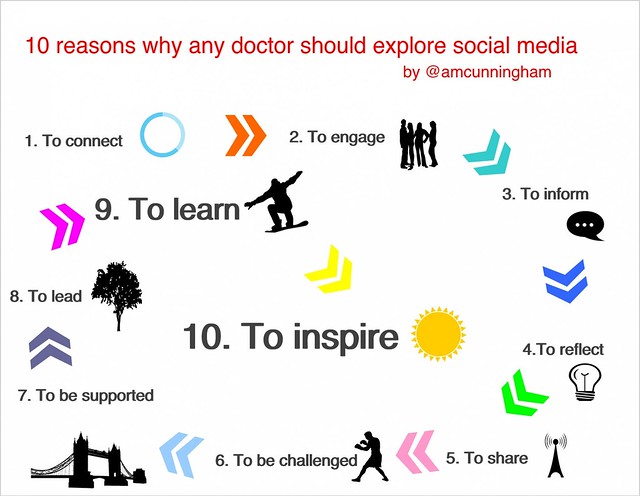
10 reasons why any doctor should explore social media

I concentrated on a few stories - Elin Roddy's experiences of learning and reflecting in social media which lead to her taking on the role of lead for End of Life care in her trust ; raising patient safety through openness and transparency of sharing the #Wrongfooted storify ; NHS Change Day ; the FOAMed initiatives of ECGClass, Gasclass and TeamHaem ; and Kate Granger's #HelloMyNameIs campaign.

A few years ago I was not confident that I could justify urging every doctor to explore social media. But it is now beyond doubt that some of the most innovative, creative and transformative conversations about improving the care of and with our patients are happening within social media.

We must ask ourselves what we can do to help our colleagues and students be part of these conversations.

Thursday, 12 December 2013

Reflections from #DotMed13


The last year has been very good for meeting great people. I first met Irish rheumatologist Ronan Kavanagh in Dublin in this year. That was in February when Shane O'Hanlon got us both to take part in a pre-conference workshop on social media at INMED (the annual scientific meeting of the Irish Network of Medical Educators). Next we met as a rheumatology conference in the UK- this time brought together by Philip Gardiner.

We Banjo 3 at #dotmed13
Last week I was back in Dublin for #dotmed13 - a conference curated by Ronan and Muiris Houston, a GP and medical journalist. It was a fascinating event. I ruminated this morning that it was like #med2 ( a tech driven conference) meets #mu13voice (medicine unboxed- a conference that seeks to explore ' a view of medicine that exceeds the technical' - Alexa Miller had similar thoughts in her blog post about the day and I think she explains it a lot better than me.

So at #dotmed13 we had banjo music and some of the most powerful storytelling I have ever heard- Jordan Grumet told some of the stories he tells in his blog of how medicine broke him and how he got back together again. Architect Ed Gavagan told us how life had broke him but how he got life back together again - helped in no small part by the bartender who took the time too listen when others didn't - and who eventually became his wife. I see many patients who have not been through exactly what Ed experienced but they have been unlucky and experienced hard and tragic lives. I must find the time to listen to them.


And after watching Alexa Miller speak at the Millenium Medicine conference in Texas earlier this year (it was live-streamed- I was at home in Cardiff- and it's well worth catching the video here) I was really excited about taking part in her workshop on how exploring art works could expand our creative approaches to medicine. She couldn't really stop us talking about Picasso's 'Girl before a mirror'!

Of course we had the techy stuff too. Lucian Engelen could not fly to Dublin because of bad weather but wowed us all by taking a picture of the audience through Google Glass from the Netherlands!  It was a great pleasure to finally meet Berci Mesko and Bryan Vartebedian who I have known for years through their blogs and twitter. They were both talking about their visions of the future of healthcare and the part that doctors would play in it. Medical student Mahmood Mirza and recent graduate Alan Corbett talked about social media and medical education- and presented a very balanced view of what students see as the pros and cons.

My own presentation revisited an idea about 10 reasons for a social media presence. In the past my orientation had been medical education alone- but I was able to share some great examples which I think make it reasonable for me to say that any doctor should explore social media. You can find the slides below.


Why does a twittering doctor tweet? - 10 reasons for a social media presence from Anne Marie Cunningham

If you get a chance to go to a conference like #dotmed13 then go. 

#1carejc - Primary Care Journal Club

This was an idea that started last summer- why don't we have an online primary care journal club? #twitjc - Twitter journal club is still going strong, but we always had the idea that wanted to try something different and try different forms of social media. A few weeks ago I spoke to Peter Sloane, an Irish GP, on google plus and he mentioned that he wanted to explore the potential of G+ for education so I suggested that #1carejc would be a great thing to try and get going.

We picked a paper on osteopathy in primary care that was suggested by David Lewis a few weeks before his death last summer. On our panel we had primary care researcher Ceri Butler who has also lived with chronic back pain for many years. Joining us from Australia was Karen Price, an Australian GP and educationalist who knew David Lewis well. I was just off the train from Cardiff to Manchester. Unfortunately we couldn't get Prof John Licciardione, the 1st author of the paper to join  the conversation- but we hope to catch up with him again.

Was it a success? Well yes, we had a good discussion about the context of this research on back pain- the experience of GPs and of patients. We had a little bit of time to discuss the research itself but we were missing the voice of the researcher. Our teething technical problems limited the amount of time we had to discuss the paper but it was only ever intended that the google plus hangout should be one part of a wider discussion about the research topic.

We hope that the discussion can continue in the google plus community we have started. And that the videos will be a resource that people can look back on. We'd appreciate any feedback you have especially if you can leave it in the google plus community.

So here it is! Skip the 1st part (technical mishaps) and start at about 27 mins in - or even at 32 mins in when Ceri starts speaking very powerfully about her experiences.